
Film noir skills, Ray Davies and Vince Guaraldi, Robert Wise's The Haunting, enhancing Orson Welles and Quiet, Please, Beatles and Led Zeppelin bootlegs on the radio, let's all go to Messiah
Tuesday 8/4/26
People in film noir excel at telling long stories after they’ve been shot and are dying. Their voices are cracked and fading at first, but then they're able to use their normal speaking voice for the next seventy minutes before the cracked and fading voice returns for a final sentence or two and they expire. They also have time/strength to make bitter jokes as asides during the telling of the tale, like they've budgeted this into their rate of blood loss. Ironically, their timing tends to have been awful over the course of events which they relate, but impeccable so far as being able to tell the whole of this story afterwards, without a minute left over.
The Kinks' Face to Face and Vince Guaraldi's early Peanuts soundtracks: melancholia that feels uplifting. Music to draw strength from, dealing as it does with sadness. Ray Davies's narrator had "too much on [his] mind," just as Charlie Brown feels like he knows too much truth (while Linus may know more truths still; Charlie Brown is likelier to be at a point of grappling in an attempt to understand, whereas Linus could have already understood and accepted). But there's still devotion to carrying on. The letdown of a holiday in Waikiki that instead further attests to the flimflammery of life and how there's little to no escape from inauthenticity regardless of the corner of the world can't be allowed to blunt a mind, like the Great Pumpkin's no-show can't blunt one's faith.
Davies' "The Village Green Preservation Society" from a couple years later is a remarkable text in addition to being a remarkable song which also utilizes melancholia as wellspring, and not for misery either. "We are the Sherlock Holmes English speaking vernacular/Help save Fu Manchu, Moriarty, and Dracula." The titular society has big aspirations, in which even arch villains are lifted up, "preserved," as it were, but more than that. Positioned to be respected and embraced. Simultaneously, the verb "help" functions as advert. We sense the group's numbers are low, so please come on out.
The society resonates as passion project under a dual aegis of, "Hey, someone has to care" and "Everything has to start somewhere." One can--and I'd say should--take these words (which sound like they've come straight from the Village Green Preservation Society charter) to also mean a hoped-for return to creativity, charm, wonder. This is maybe ironic, given the artistic fecundity of that period in music. But such a society would be a useful thing today in a world slathered in corporate paste and its artistic residuum in writing, music, and film.
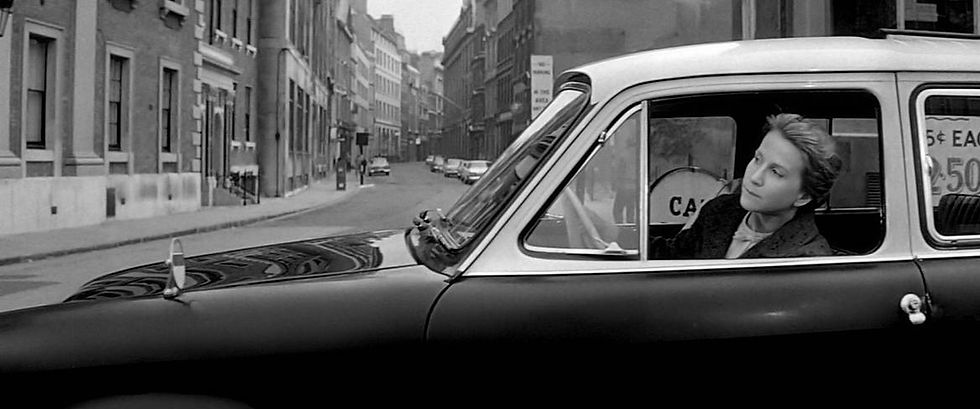
When Eleanor leaves for Hill House in Robert Wise’s The Haunting (1963), she pulls out of what’s supposed to be an underground parking garage in Boston, MA, but it’s really a London location. Could have nearly fooled this Bostonian. It reminds me of the area right around Pizzeria Regina here in the North End. There's no parking lot there, of course, but watching the film it's easy to think that maybe there once was and that's where this scene was shot.
The Haunting would be a first-ballot inductee into the horror film Hall of Fame. It has a strong case for the best horror film of the 1960s. It doesn't feel like a 1960s film, though, does it? But decades can be longer or shorter than ten years in the historical rather than calendrical sense. The Haunting is timeless, but in terms of the feel as to when it was made, it suggests the 1950s more readily than the 1960s.
Many is the day I have the theme song from The Baseball Bunch in my head, along with the Grateful Dead's "And We Bid You Goodnight," Paul McCartney's "Goodbye," the Pogues' "Dark Streets of London," and Handel's "For Unto Us a Child is Born."
Got a ticket to see Boston Baroque's performance of Handel's Messiah in December. This will be in Jordan Hall, one of my favorite places to hear music. Being in Jordan Hall adds to the experience rather than if it was in some sterile concert setting, like the Boston Baroque performance of the work I went to some years ago way off the beaten path in a part of Brighton I'd never been to before, or a bigger concert hall, depending.
Found something pretty neat: a tape someone recorded of a radio program in which the host was playing Beatles bootleg cuts. We're going back before the Anthology and subsequent reissues. You'd sometimes come across something like this slowly turning the knob on the radio in the middle of the night in the late 1980s, early 1990s, but it was very rare, and legally dubious. You'd have the feeling that the host figured no one was listening anyway so he just went for it because he thought it was cool and to keep himself entertained. Once I heard a Led Zeppelin boot from 1969 at like one in the morning. Ultra Rare Trax opened the door for much on the Beatles front. The series was incredibly important in its way.
I've been listening to a number of these classic radio programs that people have tried to improve the sound of using the new technologies. For instance, over the weekend I listened to an enhanced version of "Take Me Out to the Graveyard," a 1947 episode of Quiet, Please, a show I've written about for The American Interest and the San Francisco Chronicle. Many of the surviving Quiet, Please episodes are dogged by bad sound, more so than many other radio programs of that era. If a show could use some cleaning up, it's this one.
On the whole, I'd say the results are very fine. An issue I have noticed though with this technology is that it sometimes makes the radio actors sound like they have a lisp. Must be because of what else gets removed. I don't do this kind of work myself, so I'm not exactly sure. Also downloaded similarly enhanced versions of Orson Welles' 1938 episodes of "Dracula," which I wrote about for Vice, and "The War of the Worlds," which I was interviewed about on NPR, that he made with the Mercury.


Comments