
Hard on the trail with Lash LaRue
Tuesday 9/23/25
I believe I've seen every film in which Lash LaRue starred.
Who was Lash LaRue?
He was a "star"--we have to be a bit liberal in our use of the term, no disrespect intended--of Westerns in the 1940s and 1950s.
These were B films, made on Hollywood's so-called poverty row--meaning, a studio like PRC.
I like studios such as PRC and Republic (another outpost on the poor side of town) because you can find some virtually unknown hidden gems if you look hard enough. Well, maybe not gems. Some nice rocks, anyway. For instance, Strangler of the Swamp is a cool horror film, and Orson Welles famously, or infamously, made Macbeth for Republic.
The pictures were cheap. You got truckloads of Westerns, serials, serial Westerns, stars who were knock-offs of other stars, Bowery Boys-level comedy, some horror.
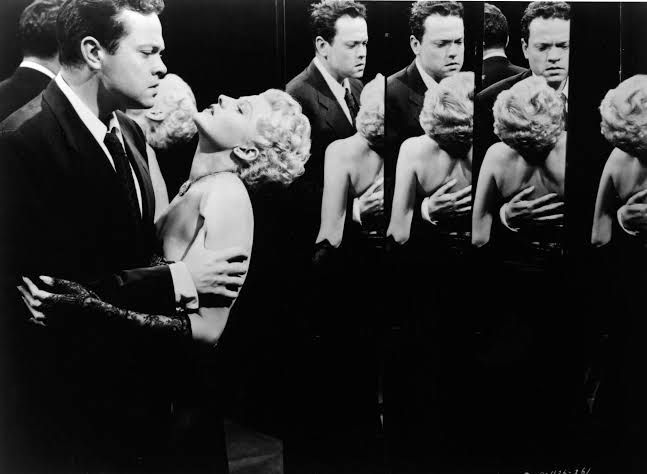
Macbeth being made for Republic in 1948--just seven years after Welles did Citizen Kane for RKO--would have really spoken at the time to just how far Orson Welles had fallen in Hollywood's esteem, and that of the public, too. Orson Welles and F. Scott Fitzgerald are alike in this regard (and others). But we're here to talk about Lash LaRue.
LaRue had a hard time getting work in Hollywood because he looked like Humphrey Bogart, and I guess one was enough. Despite being born in Louisiana--as Alfred LaRue in 1917--our boy Lash talked like he'd just been in a brawl in Hell's Kitchen. His big break came in 1945 with PRC where producer Robert Emmett Tansey came up with the plan of shooting Westerns in color--specifically, Cinecolor, a cheaper (of course) alternative to Technicolor.
This was sort of novel. B films weren't color films. Most films weren't color films. They wouldn't be for a while.
LaRue was paired with singing cowboy (there were many of these back then) Eddie Dean, playing the role of the Cheyenne Kid who disarmed his foes with a bullwhip, which is where the name Lash comes from. LaRue dressed in black, sounded a bit like Peter Brady imitating Bogey, and mostly disregarded Western conventions in his small but real way.
The pair bumped along the trail for a while, and then LaRue busted out on his own with a series of films in which he was the man rather than the sidekick. And I bet that was an exciting time for him. There were definitely kids out there who pretended to be Lash LaRue and rated him as their hero.
There used to be a Westerns station on cable. Perhaps there still is. Anyway, they'd show these Lash LaRue films. They were probably dirt cheap to license.
I'd already seen a mess of them beginning in high school--I rented what was available--but I made an effort to see as many as possible. I made notes about them. As I did with anything. Work. It's all work for me. Anything can potentially go into my pot, so I've always tried to know and experience more.
Often they only ran an hour. Or less!
I have to admit, I like that. The idea of watching a two-and-half hour superhero movie is preposterous to me. (Then again, I watch serials from the 1930s and 1940s, so maybe I'm not being consistent here, but I believe there's far more value in 1936's Flash Gordon than in 2025's The Fantastic Four, and I don't think it's a "pick 'em".)
I could get through four or five Lash LaRue pictures on a Saturday morning, depending when I got up. That wasn't nearly as early then as it is now, but from seven to ten you could see three of them and then get on with your day.
The whip was the big draw. Zorro had his saber, Lucas McCain his repeating rifle, and Lash LaRue would snap that whip and what a crack it made. He didn't talk like no cowpoke, but rather as if he were some guy doing the hard boiled Bogart voice. It was different. Didn't play to expectations. Or not all of your expectations, anyway. That is, until after you saw your first LaRue picture and realized that his others were more or less the same.
LaRue even spawned an imitation. That would be Whip Wilson. If LaRue was a B star, then Whip Wilson was a...I don't know...Like a D star. Whatever. You know what they say about imitation and flattery. Actually, it likely had more to do with how typical it was for people to copy whomever if they felt it helped them make a buck.
That's not just a Hollywood thing. Look at vaudeville and music hall culture. Do you know how many Charlie Chaplin--and Stan Laurel, for that matter--imitators there were? And that was fine for people out in the sticks, probably like it's fine for the people who go see a Deep Purple cover band or what not. Wouldn't be for me, but that doesn't mean it isn't for someone.
I recommend Return of the Lash from 1947--it's fifty-three minutes long!
Within the LaRue corpus are many, many, many henchmen, guys named Waco and the like, old mines, rot gut whiskey, scores to settle. It's Westerns Cliches 101. And I mean the top level of those cliches. We're not sticking the shovel into the earth here any more than we have to.
But the films will give you a nice little jolt. Lash LaRue has stayed with me for a long time.
I don't know how true this is, but I've heard that he was married ten times. Or at least ten times. Something like that. There were Lash LaRue comics. These sold millions of copies. For real. He appeared on the TV show The Life and Legend of Wyatt Earp. He kept acting well after his bullwhip-cracking glory days were done, and was duped--near as I can tell--into a role in the 1972 porno film, Hard on the Trail. That's more than granite just granite down below, baby. You get it.
For whatever reason, the title makes me think of an erect guy standing behind a cactus, ready to spring into coital action as soon as a stagecoach carry a convent of nuns from back east comes--yes!--around the bend, which is quite specific, I grant.
There are, if you haven't figured out by now, some tall tales that go with the LaRue legend. Another is that when he learned what he'd been a part of (the sex scenes were inserted around the unknowing LaRue's scenes), he became a missionary for ten years to make amends with the Lord, which may or may not put you in mind of the discussion Sam Phillips and Jerry Lee Lewis had prior to the latter cutting "Great Balls of Fire," or Gogol destroying his second volume of Dead Souls and ordering a nearby page--the person kind, not the paper kind--to pray. But I've also seen a quote we're he didn't sound that bothered and said, hey, at least he got paid, which suggested that sometimes he wasn't.
A footnote to the porn flick: It was shot by Gary Graver. Orson Welles fans might recognize that name as the cinematographer on many later day Welles projects. Essentially, Welles took over Graver's life. And Graver was so happy to get to work with Welles that he let him. He gave himself almost totally to Welles. It was kind of strange. Welles didn't pay him. Expected him to drop whatever to film whatever.
One time Graver was shooting his latest porn film--he shot a great many--and Welles got impatient waiting for him to finish--there's another for you--and took over the directing himself of some steamy shower sex scene I believe it was. May have even wanted to use the kind of dissolve he and Gregg Toland pioneered back in Citizen Kane and had to go with a foamy bubbles and steam kind of thing instead.
I wonder if maybe they ever discussed a Lash LaRue picture or two. King of the bullwhip!



Comments