
Mandatory viewing for kids and adults, letters, noirs, W.F. Harvey, nautical radio horror, Beatles at the Cavern, Swingin' Pig bootlegs
Wednesday 4/15/26
Kids should be shown The Best Years of Our Lives (1946) in school. Adults should be shown A Canterbury Tale (1944) in life. The former is an invaluable lesson in historical perspective; the latter ought to be considered required viewing for the soul.
I've long believed that one of the least understood challenges a person can face in this country is that of the solider returned from war. You go from those situations to perhaps being treated as if you're garbage or did nothing for the people making your life harder now. And while humans have always been humans, there was a better chance of finding a decent one in the 1940s, and a decent American. Being American could mean something conceptually. Ideologically. That's not so now.
The more a person cares about the Rock and Roll Hall of Fame--a daft and implausible construct--the less likely they are to be a thinker.
A letter from the other day which included the relevant pdf file attached.
Thought I'd share this with you. It's a volume that's quite hard to lay hands on and the definitive collection of M.R. James's ghost stories, with lots of things one can't find anywhere else--like the delightful play, Auditor and Impresario--and what I'll call scores of bonus material. Physical copies of this volume go for a small fortune. A book in any form to be treasured.
If you've never read it, read "Oh, Whistle, and I'll Come to You, My Lad." I've written about this story and its various versions professionally, given interviews about it and the film and radio adaptations of it, written about it in the Scrooge book, and talked about it many times on the journal at the site. Obviously I feel strongly about it. I'll eventually write a book about the art of M.R. James. Check out "Casting the Runes," too, especially how James begins that story. It's so ingenious. You'd never see anything like that from anyone now.
Part of another letter from the other day:
...I've been working like six hours a day on "Love, Your Mouse." (But just an hour so far today.) I thought I was done, but I wasn't. I may be now. It's a 1600 word story that a child is supposed to be able to understand. There are 7000 words of outtakes (in a document) from the story. It's a masterpiece. A gift to the world I'm not permitted to give it. Never mind be compensated as I should be for such a thing that is like nothing else there has ever been.
Did you see about the writer busted for AI and plagiarism at The New York Times Book Review who was engaged by those charming people featured a number of times at the site in Sadie Stein and Gregory Cowles? If not, look it up. I'll be doing an entry on the journal about that, too, of course.
Remember: I'm the bad guy, with the whole write better, work harder, know more, run stairs, hurt no one, personify kindness and decency thing. The monster!
That letter goes back maybe a week now. On the Friday prior to this past Friday, I opened "Mouse" expecting--insofar as I have expectations in these matters, because I never know what will happen or if something will occur to me that improves the work, until, that is, I am sure the work couldn't be improved by man or god--to read it back and find that it was finally finished, and then read it a few more times, spaced throughout the day, to confirm this.
That's not how it went. I worked on the story for six straight hours, changing the ending yet again. The road to this ending has been a long one. You wouldn't think it to read it. Sounds like the most natural thing there's ever been. And it is. But I had to do all these other things to discover and realize it.
The same thing happened the next day a couple Saturdays ago. Six more hours in the morning. Working, again, on the ending mostly. On Sunday, I worked on the story for five hours. Then, on that Monday--so nine days ago--an hour. In each instance, I'd set it aside, and work hard on something completely different, both fiction and nonfiction. And write in this record.
I watched Terror Street (1953) also called 36 Hours, a noir from Hammer--they didn't just make horror films--starring Dan Duryea. Anything with Duryea is worth watching. The film moves briskly, as it should, given its concept. Duryea's character is an Air Force pilot who has been in the States. He returns to England with a thirty-six hour pass to see his estranged wife, who is killed scarcely before he has time to say hello. Then he has the remaining hours to solve the mystery and clear his name.
Also saw The Mob (1951), with Broderick Crawford. When I use the term "mug," that's what I mean. Broderick Crawford had a classic mug. It's not a men-only thing. Women can have the classic mug as well. The mug, which is external, also conveys something about the internal. That is the nature of a mug. Usually, it's something unpleasant. Turpitude and/or brutish ignorance. Look at Mike Vrabel. But not always. There is the lovable mug. Which is what Crawford's character has, more or less, in this picture. But the useful thing for him was that his mug, in a manner of speaking, could go either way.
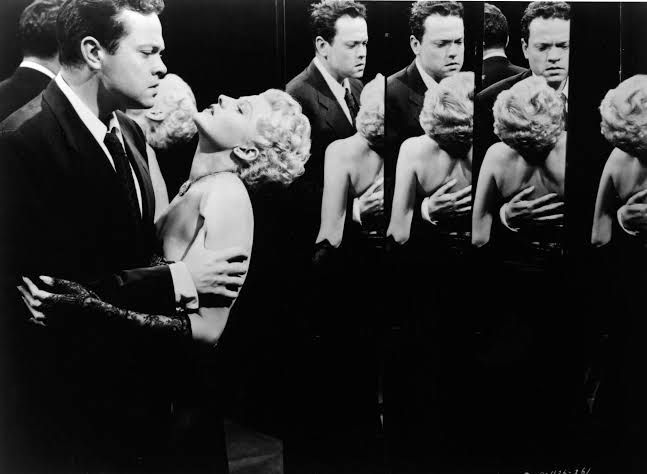
Watched Phil Karlson's Scandal Sheet from 1952. His best film was that same year's Kansas City Confidential, but this one numbers among those reliable early 1950s noirs. A noir from the early 1950s tends to be more hard-boiled than noirs from the 1940s. The latter are likelier to have femme fatales and bumped off husbands, whereas the former feature crooks--or gangs of crooks--and detectives/cops.
Scandal Sheet would pair well on a double bill with Billy Wilder's Ace in the Hole (1951) with both being about the newspaper business. We get that mug of Broderick Crawford again with Scandal Sheet. He's an unlikely movie star, perhaps, but this is noir, so not so much. Memorable face, memorable voice. In noir, the character actor can be a lead, which is one of the best things about noir. I use the term "noir" loosely; increasingly I've come to think that the one true noir as noir is to me defined is 1947's Out of the Past. It's neither a crime picture nor a thriller whereas most "noir" is.
Noir got herky-jerky near the end of its stylistic run in the late 1950s, with 1957's The Big Caper, which I also recently viewed, being a good example. It's watchable and has compelling aspects (like the "playing" house angle), but it strains against itself, as if wanting to be socially progressive and provocative without having figured out how yet.
Anytime there's a beach bongo beatnik type of guy in a noir, that's going to be less than ideal. Has that feel of the out-of-touch parent trying to do the "hip" kid lingo. The character of Zimmer in The Big Caper is an impressive psychopath even by noir standards. The school scene with the singing may have stuck with Hitchcock judging by the singing/school scene in The Birds, which I'll touch on in this long piece I'm presently writing on spring horror films.
Lots of noirs for me of late.
Acquired a best-ever sounding set of the complete Beatles recordings made at the Cavern Club. This includes the "Misery" demo that surfaced last year, with the pronoun "flip" ("I'm the kind of girl..."). Writing a piece about the complete Beatles Cavern recordings is on the near-future agenda.
Read W.F. Harvey's short story, "The Habeas Corpus Club." This just doesn't work. I have no idea what he was trying to say. Whatever he understands the concept to be isn't what the reader understands it to be. He intended it to be clever but it's a muddle.
Listened again to the Beyond Midnight (African horror radio program from the late 1960s) adaptation of F. Marion Crawford's "The Upper Berth." "The Screaming Skull" is probably Crawford's most anthologized story, but anything with an ambulatory (unattached) skull is going to be somewhat silly.
You can't go wrong with Beyond Midnight. The Old Time Radio Researchers group hasn't issued a complete set of the program yet for some reason, which is a bit surprising but hopefully they will. The people responsible for Beyond Midnight knew their horror lit. I wouldn't exactly call any of the source stories obscure, but some of them also weren't found that often in ghostly anthologies.
One reason I revisit this broadcast as often as I do is because I love nautical ghost stories and they can feel rare, certainly compared to terra firm ghost stories. Frank Cowper's "Christmas Eve on a Haunted Hulk"--which I discussed some years back on the radio--is another. That would make for a fine modern day vintage-style radio adaptation. There's actually a place out on the Cape that I bet could do a bang up job. Maybe I should pitch the idea of me writing the script and doing a production.
Got the Swingin' Pig Rolling Stones bootleg, Bright Lights, Big City, which is one of your classics of the early CD bootleg age. This is a digital version. I have the CD somewhere, but who knows where. The set features the 1963 IBC demos--which represent some of the finest recordings of the Stones as a rhythm and blues band--and then jumps nearly ten years ahead with some Exile on Main Street material.
These Swingin' Pig bootlegs were as exciting as it got at the time to someone who really knew their musical stuff. (Some of their releases repackaged Trademark of Quality boots, but this was the CD era and all's fair in bootlegs anyway.) The label was responsible for the Beatles' Ultra Rare Trax series--a game-changer in the underground universe which presaged and helped make possible so many of the historical treasures that have been a part of reissue campaigns since--and the Stones' Philadelphia Special, which remains arguably the best way to hear how the Stones sounded on their 1972 tour ("Good morning!").
There were so many Swingin' Pig mind-blowers: the Who in Amsterdam in 1969 (albeit with a tape that had yet to be speed-corrected); the Doors at the Matrix in 1967; the Beatles' Stars of '63; the Byrds' Live in Stockholm 1967. Going to the record store--the right record store, which was often way out of the way--was like going prospecting in the old mine. I'd drive long distances as a high school student in search of these treasures.
I'll write a piece on that Beatles' Ultra Rare Trax series and its influence. It is already on the "get these done soon" to-do list.



Comments