
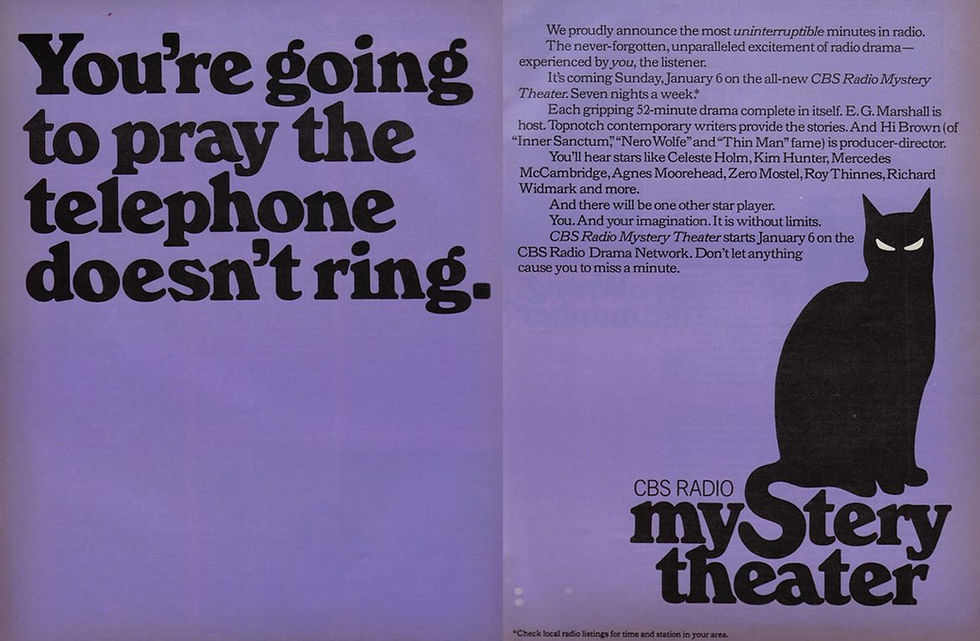
You. And your imagination.
Updated: 19 hours ago
Thursday 10/8/26
I am more interested in things from the past--music, films, art, books, shows--because they are better. Ages before ours were far more conducive to the creation of notable work or even just solid work or work at all worth one's time. These times are usually before my time. I take myself to where the quality is. I think you have to be an exceedingly stupid person to think that your average television program, say, in 2026 would be better than from the mid-1950s to the early 1960s. I think it's also highly unlikely that you've seen any program from 1959.
You watch something like Alfred Hitchcock Presents, The Honeymooners, Gunsmoke, The Outer Limits, The Rifleman, The Dick Van Dyke Show, Wanted Dead or Alive, Have Gun -- Will Travel, and it should be obvious to you how much better that show is than anything you'd see now. They're better written, more imaginatively directed and shot, better acted, populated with more interesting actors (note the quality of the character actors), with richer themes and ideas. They aren't tacky, bland, disposable. They have substance and hold up. They're distinctive.
An example: Over the weekend I was watching the season three episode "Face of Yesterday" of The Rifleman from January 31, 1961. There's a young man who is being manipulated by his stepfather into trying to goad Lucas into a gunfight. Lucas learns that the young man's biological father is the first man he, Lucas, ever killed back when he was fighting for the Union in the Civil War. He feels responsible and guilty for this situation.
Lucas delivers what's tantamount to a soliloquy about that guilt, but he's also talking, in theory, to his friend, Micah the sheriff. The latter is almost incidental, though. Sometimes when we're talking to another person we're really speaking to ourselves, even if that's not how it started out. Here we, the viewers, are listening to and watching a man wrestling with his own conscience through these voiced words that he needs to say to himself and work but as if they were being said to another.
Fear often stops us from starting what we need to tend to; if we can start almost by accident, we may find that the necessary thing is underway. You do this other thing, and you peck peck peck on the side at this additional thing, and before you know it, you're actually doing that chief thing. You've switched horses and now this is your ride.
Lucas's face is seen in close-up on the left-hand side of the shot. Micah is behind him, but also in close-up--just not as close up. Close-ups are usually single person shots. If they're diptychs, those two faces typically share the same horizontal plane. They're not vertically layered like this. You understand how the shot composition mirrors the sense of the action of the scene? Lucas foreground, both literally and symbolically, Micah--the intense listener--background, secondary, but intimately a part of this because it doesn't happen without his presence. Conversational action, but there's real emotional action, and there's action-oriented imagery because of the visuals conjured in our imaginations by Lucas's descriptions.
We can see what it looked like when Lucas killed that man because of how richly he tells his story and the use of our own imaginations, which we're being asked to put to use. Art doesn't work without your imagination. It takes both the artist's imagination--and obviously more of theirs--and yours. So what happens in a world where no one has any imagination? Where they simply need to be told things? Plainly, boringly, like in a list or as if life was one big YouTube how-to video? No one ever discusses this. Reading, watching, and listening are all skills, and they require skills within those skills, and one of those skills pertains to having and using an imagination.
The writing people can "understand," for instance, is often terrible writing, because it just tells them shit. List this, list that. There's no interactive quality, and no immersion. There aren't artists trying to do anything but essentially that form of listing; which is to say, there aren't artists anymore. That thing that people say is amazing...they're just doing that because they're parroting what they think they're supposed to say and also because their flabby minds, which they give a workout, can understand that thing, that list, that chalky blandness of the YouTube how-to video.
You would never encounter anything as well done as this late 1950s/early 1960s Western television show--which was meant for the masses--now. It--or its quality, anyway--would be lost on everyone anyway because very few people can tell what anything is. That's why what they praise is usually garbage without any skill behind it, because they "get it." Garbage doesn't contain anything that can be lost on anyone. It's simply garbage. Whether that's pop culture garbage like Taylor Swift, or "arty" garbage like Tommy Orange. It's the same garbage. It has no intrinsic value. The only thing it offers you is the chance to tell yourself additional lies and, crucially, lies about yourself.
I've cited the example of John Steinbeck before. Why do you think people on literature subreddits praise Steinbeck? Because there's nothing to Steinbeck. It's simple. Without nuance. Without technique. Without artistry. It's easier for them to understand because this is the prose version of toy blocks for a baby.
Realize: I'm not suggesting that accessibility means something is less effective as art. There is no more accessible work of writing than "What the Mouse Knew," and I know there is no art to match it, or come close, frankly. But it has a depth that nothing else by anyone else does. And it is depth that is crucial. There has to be depth or you don't have great writing.
There isn't depth in Steinbeck. (The appearance of depth to someone who isn't well read, doesn't get out much mentally or intellectually, and is, in essence, a sixth grader in adult's body when it comes to these things and their own readerly development, isn't the same as actual depth.) Steinbeck is famous as official "Great American Writer." So that person reading Steinbeck, who almost certainly wouldn't if they couldn't in turn post about it for points/attention/validation, is able to think they're smart and sophisticated, too, like they're partaking of real literature and only special people can do that.
It's a way to pat themselves on the back while having no clue and no idea of how ignorant they are. If someone suggested otherwise, they'd likely say, "Art is subjective," which it isn't at all. Preference and subjectivity are two different things. (And the former is often a direct result of one's ignorance and limitations, the latter of which are in large part self-imposed by how they live and learn, or, rather, don't.) Like sympathy and empathy, which people also don't understand.
I'm just giving you one example of typically inventive scene of a show from the year in which Roger Maris would later belt his 61 homers. The Rifleman is a succession of such things. As I watched, I thought, this has to be directed by Joseph H. Lewis. He was responsible for films like Gun Crazy (1950), The Big Combo (1955), and So Dark the Night (1946). Sure enough, it was him. I go to the better things. The better things are in the past. It's not a matter of my life and what I partook of "growing up" or anything like that. Most of these things are from before I was born. I care about the quality; not the made-on date.
Why do people only partake of and "know," insofar as they know anything, that which corresponds from the years of their own lives? We're talking anything now. If someone has a conversation about the best films of all-time, the best NBA teams, when are those films and teams from? From when they reached a certain age and up to the current day. They act as though nothing existed before they do. The reason they "know" those things--of those things--is because they didn't have to try to. They were right in front of their faces. There was no looking, no going.
It's the difference between opening your eyes and here's this stuff in your face, and traveling across town to see something over there. People are too lazy, too stupid, to do anything more than see what is in front of--and usually shoved in front of--their faces. They're also so arrogant and ignorant that they're going to make like that's all there is and ever has been, or if there was anything else, it can't be as good, because this is what they know. That's how dumb, slothful, and narcissistic we are. The result: you get much less out of life, you offer less in life. You're less good to anyone else, and to yourself.
Overlooked creepy episode of The Twilight Zone now that we’re getting deeper into October: “Stopover in a Quiet Town.” The “twist” at the end is almost beside the point; the tension is in the mystery of “What the hell is going on here?” And as a penalty for drunk driving, this seems suitable to me.
I've been watching Perry Mason. I plan on going through the entire show, as long as it takes. But again, you watch an episode, any episode, and it's like a well built house. Not some cardboard-like structure, which is what you get now. They're just so well made. Reliable quality. You're pulled in. I like the teamwork between Mason, Della Street, and Paul Drake. Della Street is an admirable character. The three have a lot of respect for each other.
Saw the first three seasons of From (2022-) and have started the fourth. There's limited tension to it, especially after we get beyond that "what is going on here?" phase. That not uncommon. For instance, the first season of Lost is the only season worth a damn (and despite the setting, makes for nice Halloween season viewing). Similar to Stranger Things and its first season (or, really, the cold open of its first episode, which is when the show peaked). We're pulled in by our natural desire to know what the deal is once we've seen a corner of the puzzle. The show loses the juice it had once we "get it."
Doesn't have to, but it does here. Then it's like this exercise in trying to become ever more grim. Which smacks of contrivance. Forced edginess. It takes away any rooting interest. An outcome can be inevitable. Fate sealed, as it were. But then the action has to be in the characters. Character is action. That action requires fluidity. These characters aren't fluid. We think of outcomes as this "big" thing, but outcomes can happen all the time. Here, though, it's just a continuous game. If this were baseball, it'd be a perpetual fifth inning.
Have also been listening to the CBS Radio Mystery Theater. I'm never not doing something art-related. There isn't a single second of my waking day that doesn't involve art. Whether that's writing and doing my work, partaking of art, thinking about it. It's a constant presence. If I'm watching the ballgame, I'm downloading some Dylan bootleg or reading about the early years of William Wyler. There's no "I'm going to eat and zone out." I'll listen to a radio program or a recording of a favorite text with the sound of the Patriots game muted. I'll listen to a radio program and read at the same time. It's easy for me to keep the words of each straight.
The CBS Radio Mystery Theatre series premiered on January 6 1974, ending on December 31, 1982. Good run. But what boggles the mind is that they made 1399 original episodes. They were each forty-five minutes long. How on earth does that happen? There's no dramatic radio series with a similar output, and by the nature of the medium those shows were prolific. You had to create a new episode for each week. With something like the early Bob Bailey run on Yours Truly, Johnny Dollar, you had a fifteen-minute episode airing Monday through Friday.
There's a lot of range in quality with the CBS Radio Mystery Theater, of course, and some padding. Forty-five minutes was a lot of time to fill. The classics of the dramatic radio medium were usually about a half hour in length, including Inner Sanctum, the earlier creation of CBS Radio Mystery Theater creator Himan Brown, of which I've noted being a huge admirer a number of times.
That show ran from 1941 to 1952, so CBSRMT amounted to quite the time-delayed comeback, when these programs had long stopped being made. It was a plucky soldier in the cause for one of America's greatest art forms, and one that is never discussed as such. I see it for what it is, though. Something like The Great Gildersleeve deserves a place alongside Moby-Dick, The Searchers, Leaves of Grass, The Journal of David Thoreau, Workingman's Dead, Out to Lunch!
A strong episode of the program: "Ghost Talk" from January 17, 1975 (which I suppose could have aired as I was conceived by parents I'd never know, something I've been thinking about since listening to this again recently and then relistening). A man dies, leaving his wife behind. She has long been of the view that if someone is remembered, they never really die. We sense, though, that that's something she's said in order not to have to experience the fullness of loss. The full reality of loss. She's tried to get out ahead of it. Life doesn't work this way, though. Her husband looks on from the beyond. Her insistence on the act--the activeness--of remembering him limits him where he is now and her future on earth. He feels guilt. An obligation to play the dutiful husband.
The husband makes a (guy) friend. They become best buds. You need someone to help you ease into these new digs. The husband eventually visits his wife in ghostly form because he because of his compassion for her, which also has this quality of duty, of timecard-punching. She has a suitor, a former friend of the late husband. But all she wants to do is talk about her deceased spouse including to this other man.
God is a character in the story. He comes by a few times and makes some strong points, even if his attention is divided because his immediate concern is a dying star and tending to its needs. There's this amusing bit later on where the deceased husband's new best friend pays a call to the grieving widow. She thinks it's her husband and instead the friend is like, "No, it's Bruce, your husband's new friend, his best friend, actually."
It's one of the better episodes of any radio program I've ever heard. Wise, witty. Makes you think. As a ghost story with true wit, put it with Richard Middleton's "The Ghost Ship" and H.G. Wells' "The Inexperienced Ghost."
Listening to these radio shows helps us become smarter. When the CBS Radio Mystery Theater was starting out, the ads for the show made this point about the power of your imagination. Saying that it was without limits. You use your imagination when you listen to these shows. They provide imagination, and you do as well. This keeps a mind healthy. Or makes it healthy. Healthier. It's not just sitting on your mental ass, cramming Doritos down your throat for hours on end. For a lifetime on end. Which is what people's lives are now tantamount to.
There's less mental flab. The muscle is stronger. Fitter, can lift more. Doesn't run to ground as quickly. Has stamina. The more you listen (or do any of a number of beneficial, bolstering activities), the fitter the mind gets. You see the story in your head. The writing provides for that, and the acting, the sound design, but so do you. It's a tandem enterprise. As reading is. The best writers involve readers the most; get the biggest contributions out of readers. They're more in it together, if you will.
The most autumnal of Oasis songs: the 1995 B side, "Rockin' Chair," and perhaps the only fall-like Oasis song. Mix of the instrumentation--the role of the acoustic guitar; very "woody"--and the sentiments conveyed through the lyrics. Something about the fading in, too. "Eight Days a Week" helps Beatles for Sale be such an autumnal album and the fade-in there also plays a part.
Heard two demos of John Lennon's "Free as a Bird" the other morning in better sound than they've ever appeared. Things keep coming out, which is one of the only benefits in my view of the digital age. You wouldn't have heard such a thing in the past, or maybe you'd eventually get wind of a rumor that it existed and been put on bootleg CD by an Italian company. Then you'd go to used record stores within however many miles--I embarked on some long trips--hoping to get lucky.


Comments